Agentic Context Engineering: Building Smarter AI Systems

Amit Eyal Govrin
TD;LR
- Agentic Context Engineering is the discipline of structuring, validating, syncing, and governing the information AI agents rely on ensuring they receive the right context, at the right time, in the right format for accurate and safe execution.
- Unlike prompt engineering, which focuses on single-task instructions, Agentic Context Engineering manages layered, persistent operational context such as configurations, policies, environment metadata, dependencies, and system state.
- Real-time syncing, versioning, policy enforcement, and context inheritance prevent common automation failures like hallucinated actions, misconfigured deployments, missing permissions, or outdated assumptions.
- With proper context engineering, AI agents transition from reactive responders into deterministic engineering collaborators capable of multi-step reasoning, safe execution, and production-grade reliability.
- Kubiya.ai enables this through its Context Catalog, Projects, Teams, Environments, and Policies providing governed, versioned, and context-aware automation for enterprise workloads.
In this blog, we will explore what Agentic Context Engineering is, why it matters, how it differs from traditional prompt engineering, and how Kubiya.ai operationalizes it to make AI systems truly context-aware, deterministic, and production-ready.
Introduction: Why Agentic Context Engineering Matters
AI automation is transitioning from simple scripts to fully autonomous agent-based systems such as Kubiya Agents, DevOps Agents, Deployment Agents, and Incident-Response Agents that can reason, plan, and execute workflows across infrastructure, applications, and environments. As these agents take on responsibilities traditionally handled by human engineers, the accuracy and reliability of their decisions become critical.
LLM-only automation is insufficient. Large Language Models hallucinate, lack environmental awareness, and produce non-deterministic results when context is incomplete. Without real-time system state, policy boundaries, dependency mappings, or configuration knowledge, they cannot safely execute production workflows. This leads to common failures such as unsafe commands, incorrect rollout decisions, missing permissions, or environment drift going unnoticed.
Agentic Context Engineering solves this problem by providing a disciplined way to structure, validate, synchronize, and govern the context an AI agent uses before taking action. Instead of improvising or relying on ambiguous text, agents operate like reliable engineers grounded in verified, machine-interpretable information about the system they are modifying.
Kubiya.ai embeds this discipline directly into its architecture. Through Projects, Teams, Environments, Policies, MCP integrations, and its Context Catalog, Kubiya ensures that every agent inherits accurate operational data, validated configurations, least-privilege access, and a versioned view of system state. As a result, every workflow is planned and executed with real-time context, deterministic logic, and enterprise-grade safety.
What Is Agentic Context Engineering?
Agentic Context Engineering is the practice of organizing, updating, and controlling all the information an AI agent needs to think and act correctly. It defines exactly what the agent should know, how that information is delivered, and when the agent is allowed to use it. Instead of giving an AI raw documents or scattered data, this discipline converts everything configs, policies, metrics, dependencies, architecture details, permissions into clean, structured, real-time context that an agent can actually understand and use safely.
Without this discipline, agents work blindly. They guess missing information, hallucinate answers, or act on stale configs. With proper context engineering, the agent behaves like a dependable engineer that always has accurate, verified information before taking action.
In simple terms, Agentic Context Engineering guarantees that an AI agent always operates with the right information at the right time. Instead of guessing or improvising, the agent consistently uses the correct configurations, policies, and environment details that match the system’s current state. It behaves predictably because its decisions are grounded in verified context rather than assumptions. It also stays within approved boundaries, acting only with the permissions and access it has been explicitly granted. Most importantly, the agent works with real-time, validated data not outdated or incomplete information ensuring every action it takes is safe, accurate, and aligned with organizational rules.
The Four Pillars of Agentic Context Engineering
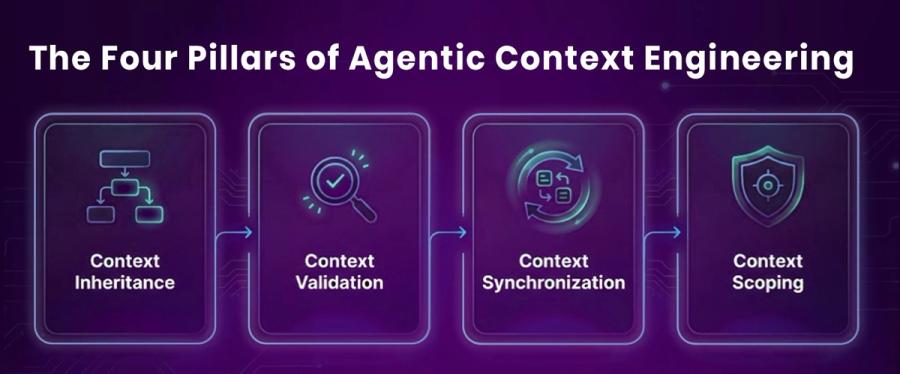
Kubiya.ai implements Agentic Context Engineering through four foundational pillars that ensure agents always operate safely, consistently, and with full situational awareness.
Context Inheritance: Kubiya.ai automatically delivers the right configs, secrets, credentials, and policies to each agent based on its position in the hierarchy Control Plane → Environment → Team → Project. This removes manual setup and ensures every agent always starts with consistent, correct, and scoped context, without drift.
Context Validation: Before any workflow runs, Kubiya validates all context for completeness, correctness, and policy compliance. It checks schemas, required fields, and permissions to prevent unsafe actions such as deploying with missing values or executing tasks without authorization.
Context Synchronization: Kubiya keeps context continuously up-to-date by syncing changes from Git, CI/CD pipelines, cloud APIs, monitoring events, and MCP tools. These updates are normalized and versioned so agents always operate on accurate, real-time system state rather than outdated information.
Context Scoping: Kubiya enforces strict least-privilege boundaries by limiting each agent’s visibility to only the specific context allowed by its project, team, environment, and policies. This prevents unauthorized access, cross-environment mistakes, and ensures secure multi-agent operations.
Why Context Determines the Quality of AI Automation
AI automation ultimately succeeds or fails based on the quality of the context it relies on. When that context is incomplete, outdated, or ambiguous, automation becomes fragile and unpredictable. This often results in misconfigured deployments, improperly enforced policies, missing dependencies, environment drift, and other operational failures that humans then must manually correct. Because AI agents make decisions based on the information available to them, poor context leads directly to poor reasoning, unsafe execution paths, and inconsistent outcomes.
Agentic Context Engineering eliminates these risks by ensuring AI agents always operate with accurate, real-time, and machine-interpretable information. Instead of guessing or acting on stale data, agents make decisions that are grounded in validated operational truth. This transforms automation from best-effort behavior into a reproducible and auditable discipline where every plan, action, and outcome can be traced back to trusted context. For engineering teams, it means safer workflows, predictable automation, and systems that behave consistently across environments and use cases.
Context Engineering vs Traditional Documentation-Driven Automation
Traditional documentation systems like Confluence pages, wikis, Markdown files are designed for humans, not AI agents. They are static, manually updated, and lack the real-time system awareness required for safe automation. As a result, any automation that depends on documentation inherits its limitations: outdated information, missing details, or ambiguous instructions.
Agentic Context Engineering replaces this fragile model with structured, machine-readable, continuously synced context that AI agents can reliably use for reasoning, planning, and execution.
To illustrate the difference, the table below captures how documentation-based automation compares to context-engineered automation:
| Feature | Documentation-Driven Automation | Documentation-Driven Automation |
|---|---|---|
| Nature of Information | Static text written for humans | Typed, structured, machine-interpretable objects |
| Update Mechanism | Manual, slow, error-prone | Automated syncing (pull, push, event-driven) |
| State Awareness | None; cannot reflect live system state | High; reflects real-time infra, configs, pipelines |
| Policy Handling | Tribal knowledge; not enforceable | Enforced policies, least-privilege, compliance-safe |
| Execution Behavior | Unpredictable; depends on interpretation | Deterministic, validated, versioned execution |
| Automation Suitability | Poor agents cannot safely act on text | High agents consume validated, engineered context |
The Components of Agentic Context
Agentic context is not a single dataset or configuration file, it is a multi-layered representation of everything an AI agent must understand to operate safely inside an engineering organization. Each layer contributes a different dimension of operational knowledge, and together they form the full situational awareness required for deterministic automation.
Infrastructure context captures the real state of cloud resources, Kubernetes clusters, VPCs, load balancers, IAM roles, network rules, and runtime environments. This allows agents to understand where workloads run and how infrastructure is configured before taking any action.
Application context includes service manifests, Helm charts, YAML configs, environment variables, dependencies, and build artifacts. This gives agents the information needed to deploy, validate, troubleshoot, or update applications with precision.
Deployment context provides visibility into CI/CD pipelines, past rollout histories, current build versions, image tags, and known failure points. With this, agents can plan safe deployments, detect drift, or roll back intelligently.
Operational context consists of logs, metrics, alerts, SLO signals, runbooks, and incident patterns. This enables agents to diagnose issues based on real system behavior rather than relying on assumptions.
Security context governs what agents are allowed to do. It includes IAM permissions, policy rules, access scopes, compliance boundaries, allowed actions, and approval workflows ensuring every step respects least-privilege and organizational guardrails.
Organizational context provides higher-level metadata about projects, teams, goals, ownership, constraints, and dependencies. This helps agents understand who owns what, why something matters, and how different components relate.
Kubiya.ai unifies all these layers into a coherent, machine-readable context model that is continuously synced, validated, and scoped. As a result, agents can reason, plan, and execute with full awareness of the environment they operate in much like a well-informed engineer, but with deterministic precision and real-time data.
Context Modeling: How Kubiya Structures Context
Kubiya structures all contexts as typed, metadata-rich objects that follow strict boundaries. Instead of dealing with ambiguous documents or loosely formatted configs, every element such as resources, policies, credentials, environment variables, configuration schemas, or architectural metadata is represented in a consistent, machine-interpretable format. This modeling approach ensures that agents always understand what each object is, how it should be used, and which rules apply to it. By defining clear boundaries across Projects, Teams, and Environments, Kubiya guarantees that agents operate with scope-aware context that reflects organizational intent, ownership, and permission structures. This eliminates guesswork and provides a deterministic foundation for planning and execution.
Context Syncing: Maintaining Real-Time Accuracy
For an AI agent to act safely, its context must reflect the true, current state of the system, not a snapshot from minutes, hours, or days ago. Kubiya maintains real-time accuracy through a multi-channel syncing engine that continuously pulls updates from Git repositories, CI/CD pipelines, cloud provider APIs, and Kubernetes clusters, while also ingesting push-based signals from webhooks, deployment completions, policy rotations, and commit events. In fast-moving environments, event-driven updates from pipeline triggers, alerts, infrastructure changes, and MCP outputs ensure that context stays aligned with ongoing system activity. After each update, Kubiya normalizes and versions the incoming data so agents always operate on clean, structured, validated context objects. This prevents stale state, drift, or outdated assumptions from influencing automated decisions.
Context Governance: Ensuring Safety and Compliance
Accurate context is not enough; agents must also operate within strict safety and compliance boundaries. Kubiya enforces robust governance across every stage of reasoning and execution. This includes least-privilege access controls, scoped context visibility, versioned policies, environment-specific restrictions, approval workflows, and guardrails that limit what an agent can do and where it can act. At runtime, Kubiya’s deterministic workflow engine evaluates every step against active policies to ensure that no action violates organizational rules or exceeds authorized permissions. This governance model transforms automation from a risky, free-form process into a controlled engineering discipline where every decision is accountable, auditable, and aligned with enterprise requirements.
How Agentic Context Powers Deterministic Execution
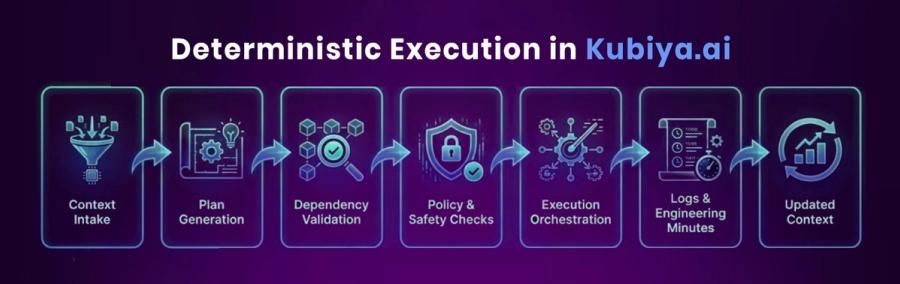
Deterministic execution means an agent produces the same safe, predictable outcome every time when given the same inputs. This is only possible when the agent has validated context, consistent system state, and strict policy guardrails. Kubiya.ai achieves this by grounding every decision in structured, real-time context rather than model improvisation. Below are the core ways context drives deterministic behavior, with examples that map to real engineering workflows.
Plan Generation
Context gives the agent a complete understanding of the system so it can generate a workflow that is safe and aligned with real infrastructure. For example, if an engineer requests “deploy the payments service,” Kubiya checks the service’s config, environment, active policy, and rollout strategy before generating the plan. Instead of guessing steps, the agent builds a deployment workflow that matches the validated configuration and environment requirements.
Dependency Validation
Before executing any step, the agent checks that all dependencies are present and valid. If a rollout requires a specific container tag, a database migration, or a certain IAM role, Kubiya verifies them upfront. If a dependency is missing such as a misconfigured manifest or missing secret the agent stops immediately rather than executing a risky workflow.
Safety Checks
Every action is evaluated against policy boundaries to ensure the agent is allowed to perform it. For instance, if a workflow includes restarting a production cluster, Kubiya verifies whether the requesting user, team, and environment have the required policy permissions. If not, the agent halts the action and surfaces a clear explanation instead of performing an unsafe operation.
Error Handling
When an error occurs, the agent uses context to choose the correct recovery path based on documented patterns. Example: If a deployment fails due to insufficient replicas, Kubiya checks autoscaling policies, current cluster load, and error logs to decide whether to retry, scale nodes, or roll back. Agents never guess the recovery action—they follow validated, predictable patterns stored in context.
Execution Orchestration
Complex engineering workflows require precise coordination across multiple systems, APIs, and environments. Kubiya uses context to orchestrate these steps in the right order, using the right credentials, targeting the correct environment. For example, a blue-green deployment involves provisioning, traffic shifting, validation, and deprecation steps—all executed deterministically because the agent understands environment boundaries and service states.
Kubiya’s Deterministic Model
By combining structured context, policy rules, and real-time runtime data, Kubiya.ai prevents hallucinations, avoids unsafe behavior, and ensures each workflow runs exactly as expected. No improvisation, no ambiguity, just consistent, traceable, production-safe execution.
Use Cases of Agentic Context Engineering
Agentic Context Engineering unlocks a wide range of high-value automation capabilities by ensuring every agent operates with accurate, validated, and scoped context. When context is engineered rather than improvised, AI agents can perform complex operational tasks with the same reliability as human engineers, but with greater speed, consistency, and determinism.
From safe deployments to real-time diagnostics, multi-agent coordination, and compliance-aligned workflows, these use cases highlight how context becomes the decisive factor in automation quality. Below is one practical example demonstrating how engineered context drives predictable and trustworthy automation outcomes.
1. Environment Drift Detection with Config Comparison
This use case demonstrates how engineering teams can detect environment drift by comparing staging and production configuration files using GitHub Actions. The workflow automatically compares YAML files and flags differences, ensuring that deployments are safe, consistent, and compliant.
Step 1: Create a New Repository
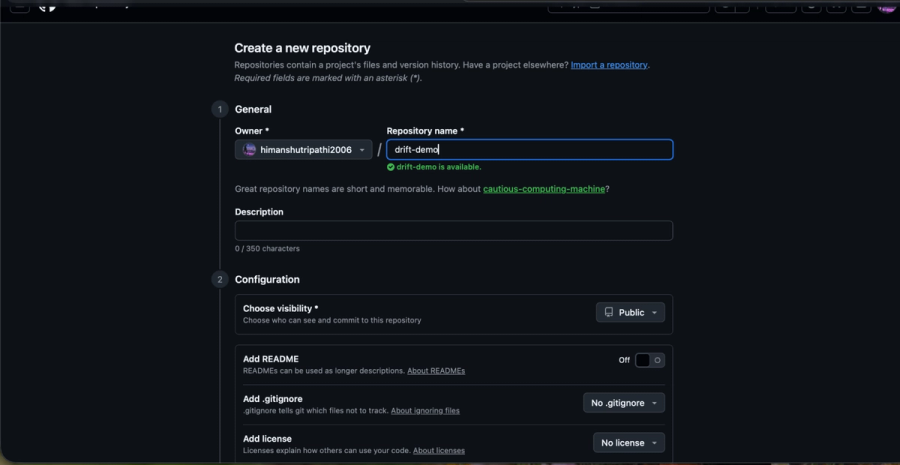
This screenshot shows the GitHub “Create a new repository” page, where the repository name drift-demo is entered. No additional configurations are selected yet.
Step 2: Open Repository in GitHub Codespaces
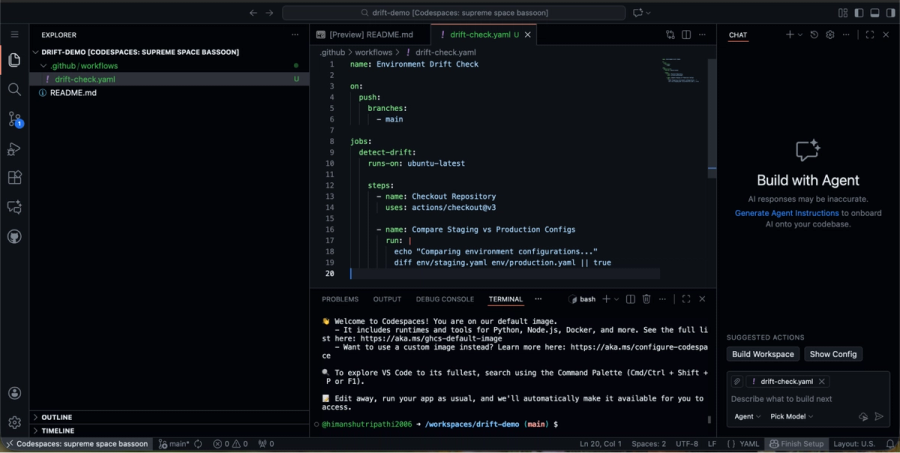
Action:
Create folders and workflow file:
.github/workflows/drift-check.yaml
Push  the code :
name: Environment Drift Check

on:
  push:
    branches:
      - main

jobs:
  detect-drift:
    runs-on: ubuntu-latest

    steps:
      - name: Checkout Repository
        uses: actions/checkout@v3

      - name: Compare Staging vs Production Configs
        run: |
          echo "Comparing environment configurations..."
          diff env/staging.yaml env/production.yaml || true
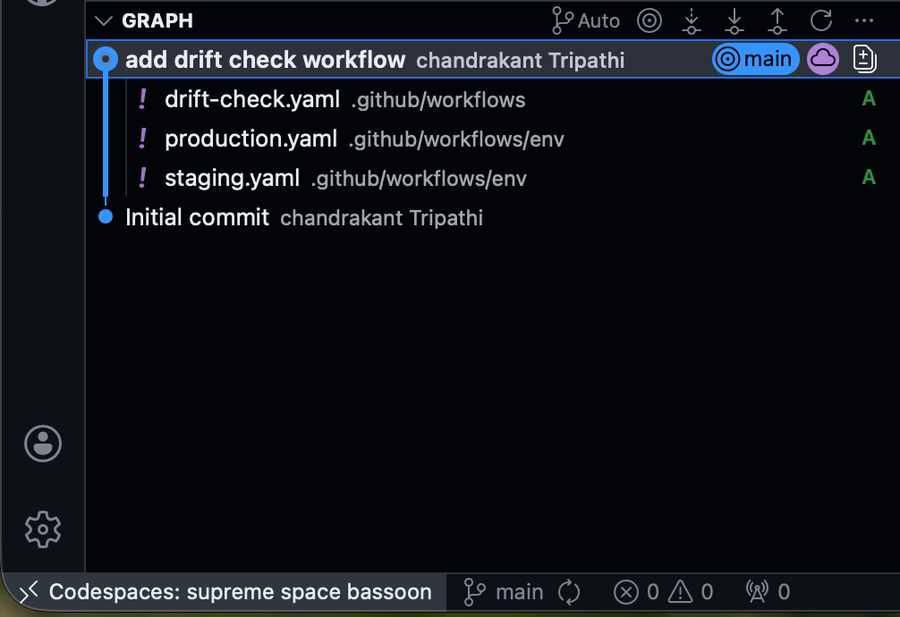
Step 4: Add Environment Config Files
Shows the VS Code source control panel with staging.yaml, production.yaml, and drift-check.yaml added.
Step 5: Commit and Push All Files
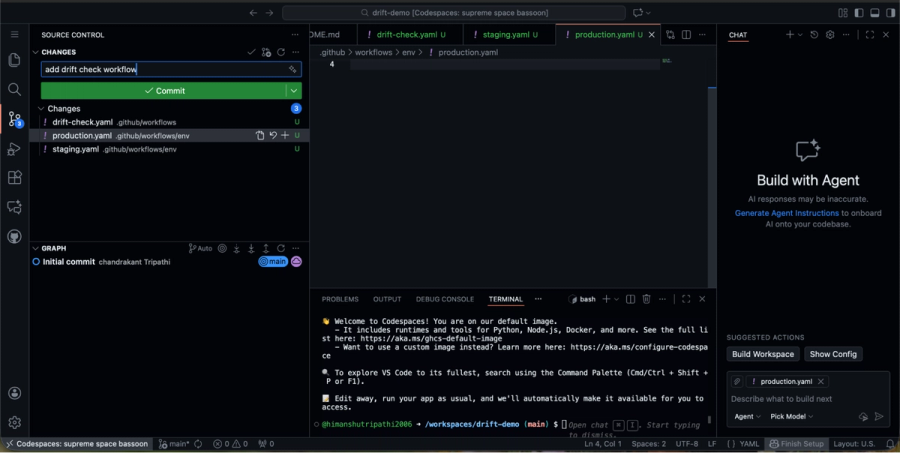
Shows a commit titled add drift check workflow containing three files: the workflow and two YAML configs.
Step 6: View Workflow Runs in GitHub Actions
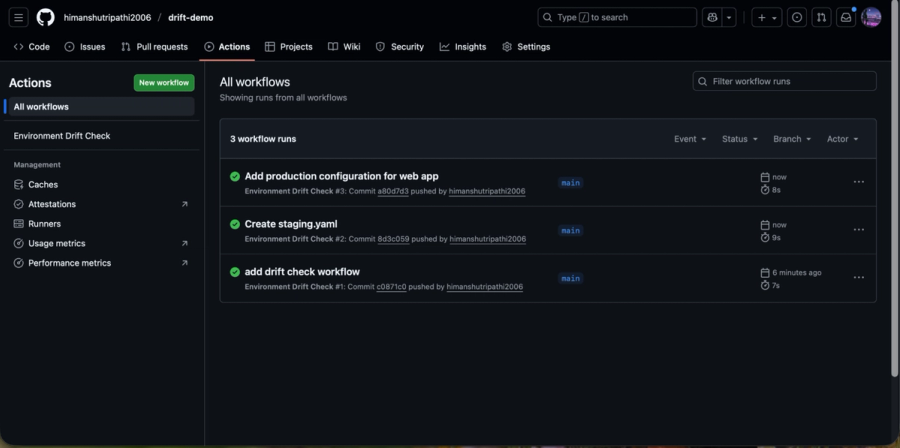
Shows the “All workflows” section with three runs:
- Add production configuration
- Create staging.yaml
- add drift check workflow
This confirms the workflow is running automatically.
Step 7: View Drift Detection Output
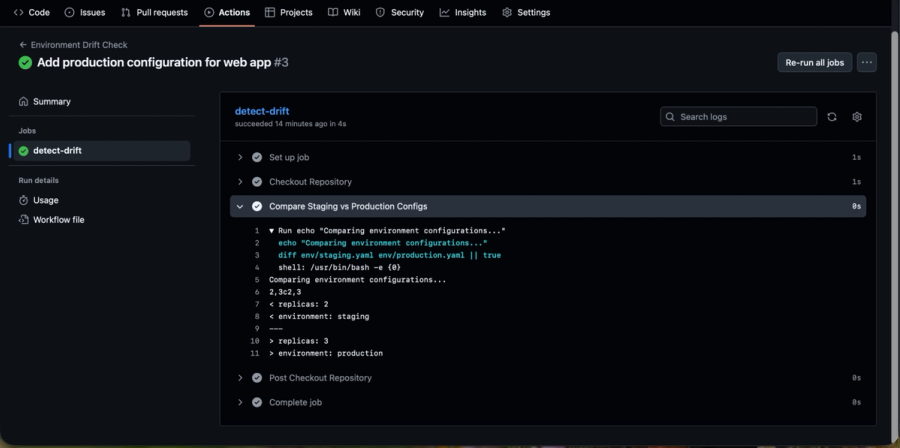
This output shows how to detect environment drift using GitHub Actions. By comparing staging and production YAML configuration files, engineers can automatically surface unintended differences before they cause deployment failures. The workflow fetches configuration files, runs a deterministic comparison, and outputs the diff directly inside GitHub Actions logs.
Conclusion
Agentic Context Engineering is more than an upgrade to AI automation; it is the foundation that transforms autonomous agents from probabilistic responders into deterministic, production-safe engineering collaborators. As teams rely on agents for deployments, operations, incident response, and infrastructure management, the tolerance for ambiguity disappears. Agents must operate with the same rigor and certainty as experienced engineers, not on assumptions, stale documentation, or ad-hoc prompts.
By grounding every agent decision in validated, real-time, scoped, and policy-governed context, Agentic Context Engineering eliminates the root causes of automation failures: hallucinations, misconfigurations, missing dependencies, outdated state, and unsafe execution paths. It replaces guesswork with a reproducible, auditable engineering discipline where every workflow can be traced back to verified context rather than model improvisation.
Kubiya.ai brings this discipline to life through its Context Catalog, Projects, Teams, Environments, Policies, and MCP integrations creating a continuously synced, versioned, and least-privilege context backbone for agentic automation. Kubiya’s agents never guess; they inherit the correct context, validate it, synchronize it, and execute deterministically across environments. For engineering teams and enterprises, this means safer automation, predictable workflows, reduced operational risk, and AI systems that behave reliably at scale, powerful, compliant, and production-ready.
Frequently Asked Questions
What is Agentic Context Engineering?
It is the practice of structuring, validating, syncing, and governing the context AI agents use to reason and execute actions safely.
How is it different from a Context Catalog?
The Context Catalog is a component; Agentic Context Engineering is the broader discipline governing how context is modeled, delivered, and controlled.
What problems does it solve?
Hallucinations, unsafe actions, outdated state, missing dependencies, misconfigurations, and non-deterministic automation.
How does Kubiya manage context safely?
Through Projects, Environments, Policies, the Context Catalog, and strict versioning.
Does context inheritance replace manual configuration?
Yes agents automatically inherit the correct context from Project → Team → Environment layers.
Can context be audited or versioned?
Yes. Kubiya version-controls all context objects and provides full audit trails.
How do agents use context at runtime?
Context drives reasoning, planning, validation, policy enforcement, and execution flow.
About the author
Amit Eyal Govrin
Amit oversaw strategic DevOps partnerships at AWS as he repeatedly encountered industry leading DevOps companies struggling with similar pain-points: the Self-Service developer platforms they have created are only as effective as their end user experience. In other words, self-service is not a given.