The Architecture of a Context Catalog: Sources, Syncing, and Versioning

Amit Eyal Govrin
TD;LR
- Engineering teams need a modern Context Catalog to aggregate, normalize, synchronize, and version the knowledge AI agents use for automation.
- Kubiya.ai provides this capability natively through a unified context layer that powers deterministic workflows and safe, policy-governed execution.
- A Context Catalog ensures that agents always operate from accurate, structured, and real-time knowledge rather than scattered documentation.
- By enforcing versioning, inheritance, and environment-specific context, Kubiya.ai enables enterprise-grade reliability across deployments, operations, and incident response.
- This guide explains how a Context Catalog works, why it is critical for agentic automation, and how engineering teams can adopt the same architectural pattern using Kubiya.ai.
A Context Catalog replaces outdated documentation with a continuously synchronized, structured source of truth for AI-driven automation. Kubiya.ai embeds this model into its platform to provide predictable, safe, and scalable engineering execution across teams and environments.
Introduction
AI automation has evolved far beyond the days of writing simple shell scripts or Python cron jobs that handle a single, predictable function. Modern engineering teams now depend on autonomous agents capable of executing end-to-end operational workflows—deploying services, diagnosing incidents, collecting diagnostics, validating configurations, and orchestrating tasks that span multiple systems, environments, and dependencies.
For these agents to operate safely and deterministically, they must have an accurate understanding of their environment: the current infrastructure state, the policies that govern access, the configuration versions in use, and the contextual conditions that shape every action. Static documentation, wiki pages, and tribal knowledge cannot provide this level of precision. They are not real-time, they cannot reflect system state changes, and they do not give agents the structured, machine-interpretable detail required for automated execution.
This is why AI agents need a Context Catalog unified, continuously synchronized, versioned layer of truth that standardizes everything an agent must know before taking action. Instead of guessing or relying on outdated references, agents operate from a reliable source of structured context that eliminates ambiguity and prevents unsafe decisions.
Kubiya.ai implements this architecture natively. Its Control Plane and Projects automatically combine context inheritance, live syncing, policy governance, and version tracking into a single model. Kubiya’s agents don’t search across scattered systems; they consume a unified context layer containing infrastructure details, configuration metadata, environment settings, and DevOps signals in real time.
This blog explains what a Context Catalog is, why it is a foundational requirement for agentic automation, and how Kubiya.ai operationalizes this architecture to help engineering teams scale automation safely, predictably, and with enterprise-grade reliability.
What Is a Context Catalog and Why It Matters
A Context Catalog is a structured and continuously updated repository of operational knowledge that AI agents rely on to perform tasks accurately. It aggregates data from multiple systems cloud platforms, CI/CD pipelines, documentation tools, metric stores, and policy engines and transforms it into semantic and operational context that agents can interpret at runtime. This unified context layer becomes the authoritative source of truth that governs every decision an agent makes.
The core value of a Context Catalog lies in its ability to consolidate diverse information into a single, machine-readable knowledge layer. It provides semantic structure, operational meaning, and environmental specificity. It ensures deterministic execution by controlling precisely what context an agent can access and use. It standardizes references, syncing, and version histories, enabling reproducibility, auditability, and governance.
Kubiya.ai enhances this model by allowing agents to inherit context automatically from projects, teams, and environments. An agent executing in Kubiya has immediate access to the correct configurations, permissions, credentials, policies, and runtime settings, ensuring consistency and safety across automation workflows.
Why Traditional Documentation Is Not Enough
Traditional documentation systems Confluence pages, wiki entries, Markdown files were not designed for agentic automation. They are static, manually updated, and written for humans rather than machines. Because they cannot reflect real-time system changes or provide structured operational meaning, they fail as a reliable foundation for autonomous execution.
Documentation lacks live state awareness. It cannot capture differences between staging and production or reflect cluster changes that occurred minutes ago. It does not track version history in a way that agents can use for rollback decisions. Knowledge is spread across multiple platforms, making it nearly impossible for automation to assemble a unified view. As a result, AI agents acting on documentation will often rely on outdated, incomplete, or contradictory information, leading to inconsistent and unsafe workflows.
A Context Catalog eliminates these problems by providing structured, updated, and versioned knowledge that reflects real operational conditions rather than human-authored approximations.
Context Catalog vs Traditional Documentation Systems: A Comparison
Traditional documentation systems were designed for humans, not automation. They store information as static pages, depend heavily on manual updates, and offer no awareness of system state or dependencies. A Context Catalog takes a fundamentally different approach by modeling knowledge as structured, typed objects that reflect real-time conditions across infrastructure, pipelines, and environments. This gives AI agents the semantic and operational context they need to reason about deployments, changes, and incident diagnostics safely. The table below highlights how a Context Catalog expands the capabilities of documentation by introducing automated syncing, deep integrations, live state awareness, and automation-ready data structures that directly power Kubiya’s deterministic workflows and context-aware execution engine.
| Feature | Traditional Documentation | Context Catalog |
|---|---|---|
| Structure | Stored as static pages or wiki entries written for humans. | Modeled as typed, structured objects that AI agents can interpret reliably. |
| Updates | Depends on manual edits, often leading to outdated content. | Automatically synchronized with live systems through pull, push, or event-based syncing. |
| Context Awareness | No awareness of relationships, dependencies, or system state. | Embeds semantic and operational context so agents understand meaning and dependencies. |
| Integration | Limited integration with DevOps tools or cloud environments. | Connects natively to cloud providers, CI/CD pipelines, Kubernetes, and observability stacks. |
| Real-Time State | Cannot reflect changing configurations or live infrastructure conditions. | Continuously updates context to mirror real-time metrics, deployments, and system status. |
| Automation-Readiness | Not suitable for automation agents cannot reason over static text. | Designed for automation; context feeds directly into Kubiya’s deterministic workflows. |
Kubiya’s Context Catalog expands these advantages by enabling project-level context sharing, team-level knowledge inheritance, and environment-aware execution. This ensures that agents execute workflows with consistent inputs, predictable behavior, and governed safety controls across every action they perform.
Architecture Overview: How a Context Catalog Works
A Context Catalog is built on three core architectural pillars: sources, syncing, and versioning. Sources define where context originates, syncing ensures the catalog remains aligned with real-time state, and versioning preserves historical accuracy and rollback safety. Kubiya.ai implements these pillars through its Control Plane and Project system. The Control Plane manages routing, policies, configuration, and integration with MCP servers and Skills. Projects define goals, constraints, knowledge, and resource boundaries. Agents use the context supplied by these components to execute deterministic, safe, and governed workflows.
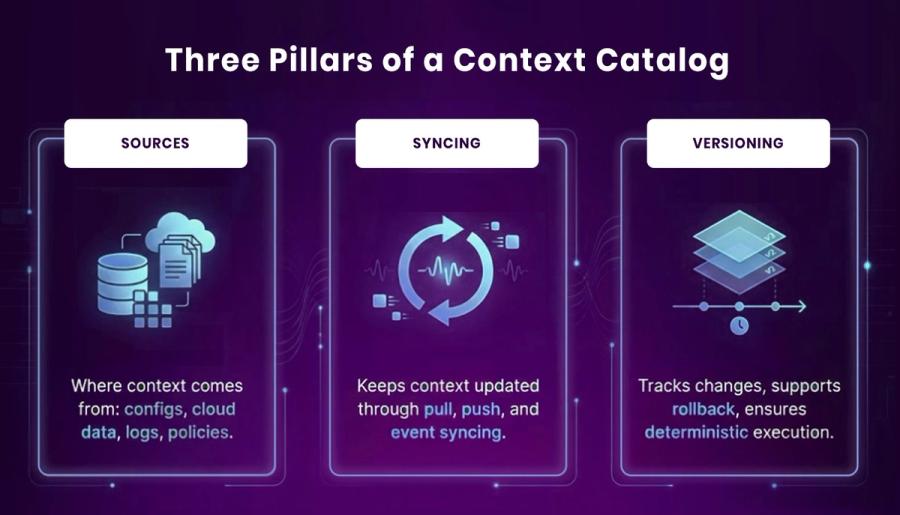
A three-pillar infographic showing how Sources, Syncing, and Versioning form the foundation of a Context Catalog used for safe and deterministic AI automation.
Sources: Where Context Comes From
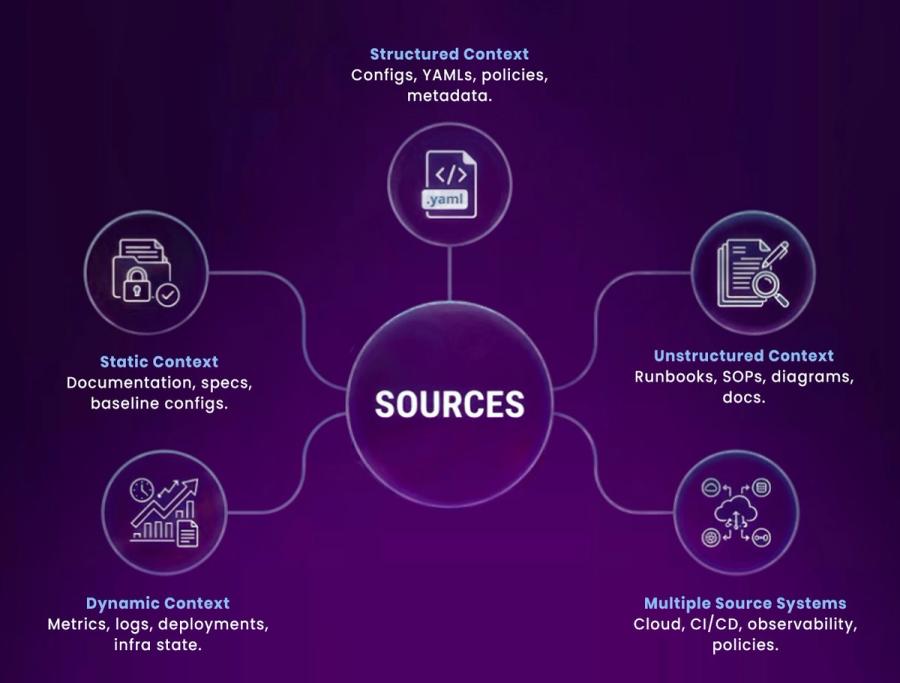
Context originates from numerous systems across an organization. Documentation from platforms like Confluence, GitHub, or Notion contains human knowledge. DevOps pipelines contribute CI/CD artifacts, manifests, and cluster metadata. Cloud infrastructure provides details on VPCs, IAM policies, compute resources, and network configuration. Logging and observability tools supply metrics, logs, and alerting data. MCP servers and Skills introduce domain-specific and system-specific capabilities. Projects and environments contribute goal-oriented context, constraints, and runtime configuration. Policies define permissions and guardrails. Kubiya.ai brings all of these sources together into a unified context layer that agents can use at runtime.
Structured vs Unstructured Context
Structured context includes configuration files, YAML manifests, policy definitions, resource metadata, and API responses. Unstructured context includes runbooks, SOPs, troubleshooting guides, architecture diagrams, and design documents. Kubiya normalizes both structured and unstructured sources into a machine-interpretable context layer, allowing agents to use them consistently across automation workflows.
Static vs Dynamic Context
Static context refers to documentation, specifications, and baseline configurations that do not change frequently. Dynamic context refers to live metrics, deployment changes, runtime logs, infrastructure state shifts, and policy updates. Kubiya combines static and dynamic context so that agents have both foundational understanding and real-time insights necessary for reliable execution.
Syncing: How Context Stays Updated
Syncing is the mechanism that ensures the Context Catalog remains accurate as conditions change. Kubiya.ai supports pull-based syncing, where the Control Plane periodically retrieves updates from Git repositories, cloud APIs, or cluster endpoints. Push-based syncing occurs when external systems notify Kubiya of changes, such as new commits, policy rotations, or deployment completions. Event-based syncing uses streaming data or pipeline triggers to update context immediately when relevant infrastructure events occur.
After syncing, Kubiya performs context normalization by cleaning, structuring, and mapping raw inputs into consistent context objects. Sync behavior can be configured for different contexts: real-time updates for critical systems, scheduled updates for stable resources, or on-demand updates controlled by teams. Policies define boundaries for syncing to protect governance and ensure compliance.
Versioning: Tracking Changes, Ensuring Safety
Versioning ensures that every workflow has an authoritative and traceable reference point. Without versioning, automation becomes non-deterministic, because agents cannot guarantee that the context used at execution time matches the environment state when the workflow was created. Kubiya maintains detailed version histories for all context objects, enabling reproducibility and safe rollback.
Versioning is critical for several reasons. Agents require deterministic inputs to avoid inconsistent behavior. Rollbacks rely on complete historical context. Audits require clear change logs. Policies often change and must be tracked over time. And multi-agent collaboration depends on shared, stable versions of context.
Semantic Versioning for Context Objects
Kubiya applies semantic versioning to context updates based on their impact. Minor metadata changes create low-impact version increments. Major structural changes create significant version shifts. Policy or permission updates modify context in ways that must be tracked precisely to maintain safety and compliance.
Snapshotting and Time-Based Versions
Kubiya creates snapshots of context during critical actions such as workflow planning, task execution, policy updates, or environment changes. These snapshots ensure that workflows can be reproduced exactly as they were planned, even if the broader environment continues to evolve.
Rollback Mechanisms
Rollback allows Kubiya to revert to a previously stable context version if a workflow encounters errors or unexpected outcomes. This ensures deterministic recovery and protects systems from cascading failures caused by incorrect or incompatible context.
Conflict Resolution
Kubiya resolves context conflicts through priority hierarchies, policy overrides, and inherited rules. This prevents contradictory sources from confusing agents and ensures that credible, authoritative context wins over ambiguous data.
Use Cases: How Engineering Teams Use a Context Catalog
Safer Deployments with Context-Aware Automation
Modern deployments fail not because CI/CD is broken, but because context is missing outdated configs, mismatched versions, incorrect environment values, or drift between clusters and repositories. A Context Catalog solves this by giving AI agents an authoritative, real-time understanding of service configuration, infrastructure state, and policy boundaries.
In this example, we demonstrate how even a simple GitHub repository + GitHub Actions workflow becomes a source of structured context. Kubiya-style agentic systems use this synced context to validate deployments, prevent misconfigurations, and ensure deterministic execution across environments.
Step 1: Create a Configuration Repository
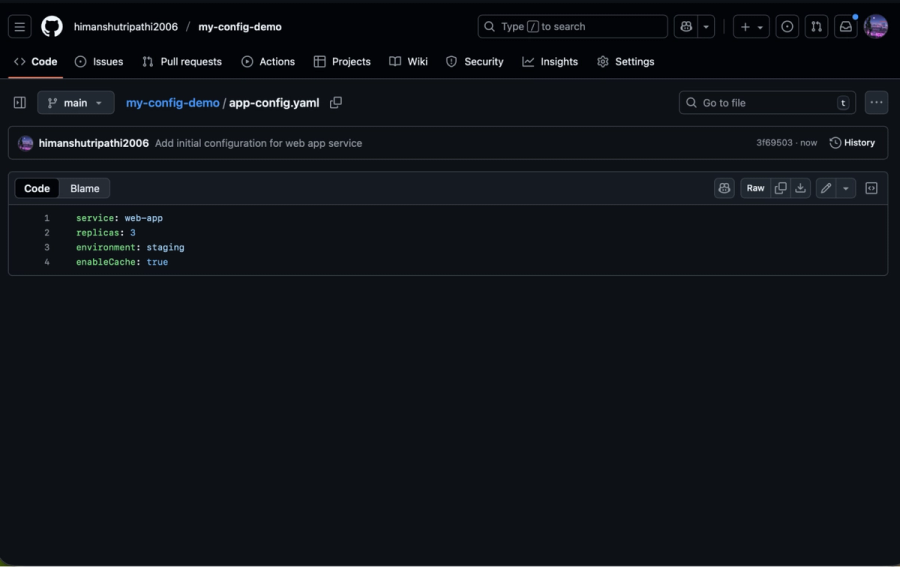
This screenshot shows the configuration file stored in GitHub. It serves as the structured context source that automation agents reference during deployments.
This GitHub repo contains a single YAML file that represents a service configuration. Kubiya-like agents treat this as a structured context object.
Step 2: Add a Validation Workflow (CI as Context)
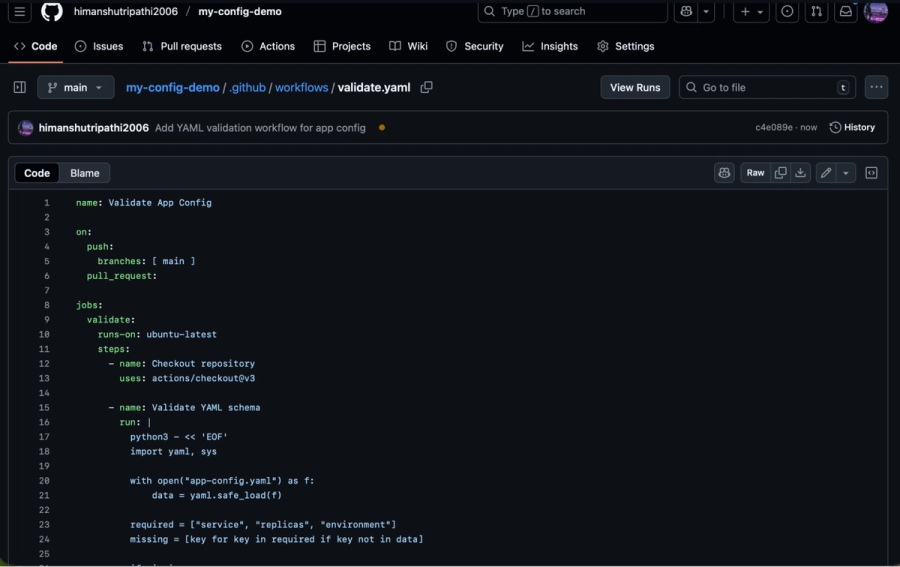
This workflow defines a YAML validation job triggered on every push.It ensures configuration files remain consistent, complete, and deployment-ready before execution.
A small GitHub Actions workflow validates the YAML schema.This takes CI from “just automation” to a source of truth the Context Catalog can ingest:
- Required fields: service, replicas, environment
- Detects missing or malformed fields
- Ensures consistent config before deployment agents consume it
Step 3: Push a Change to Trigger Syncing & Validation
When the config updates, the workflow runs automatically. This creates a clear history of changes critical for versioning in a Context Catalog.
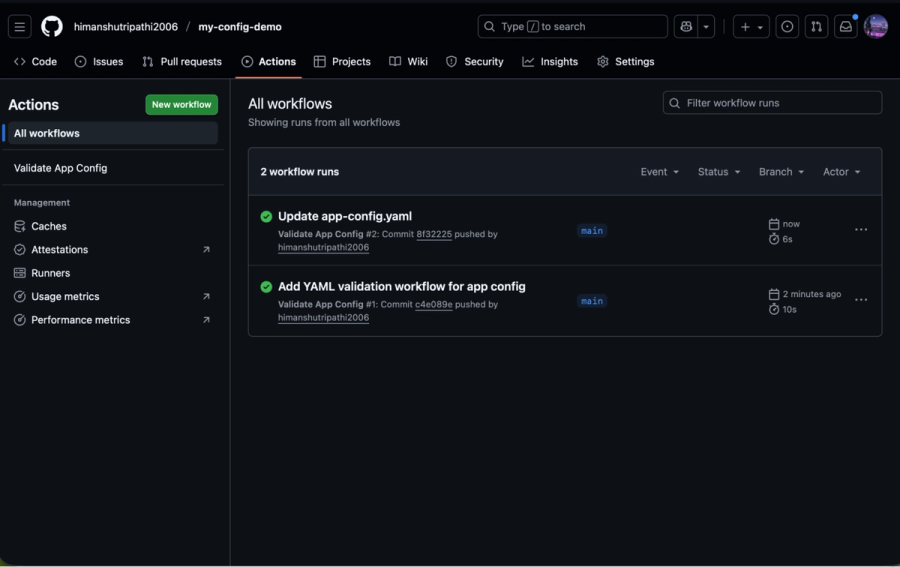
This panel displays all workflow runs for the repository. Each run reflects a synced and versioned change, forming part of the Context Catalog’s update history.
Step 4: View the CI Validation Result
This shows the schema validation output exactly the kind of structured, machine-readable data used by deployment agents.
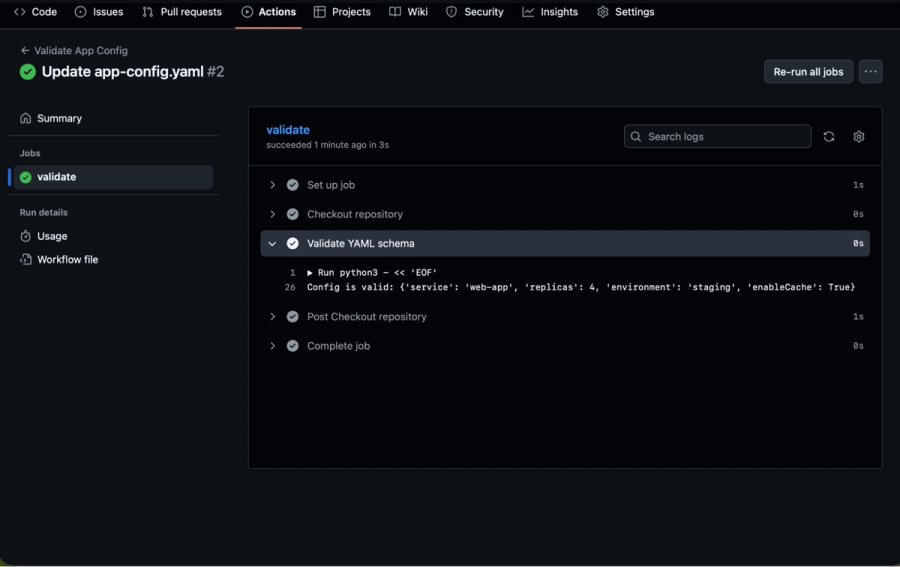
These logs show the validation step successfully parsing and verifying the YAML config.
Such machine-readable output becomes the operational context used by deployment agents.
Step 5: Completed Validation (Context Ready for Deployment)
A final success indicator.This validated configuration becomes a safe-to-use context for deployments.
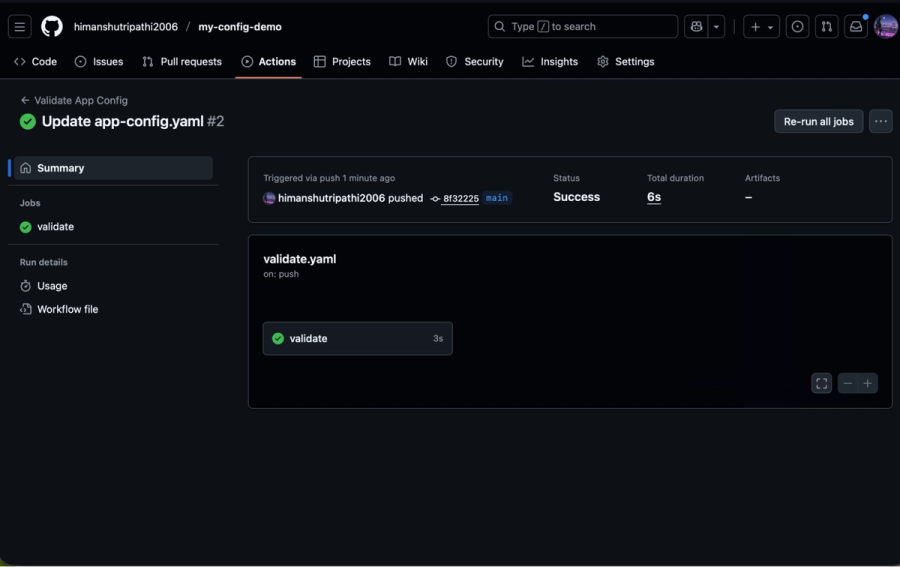
This summary confirms the validation job completed successfully.It verifies that the configuration is safe, consistent, and ready to be consumed for deployment workflows.
Conclusion
A Context Catalog is the backbone of reliable AI automation. It replaces static, outdated documentation with a live, structured, and versioned knowledge layer that agents can trust for safe decision-making. In complex engineering environments, deterministic behavior is essential; agents must operate with predictable inputs, consistent context, and governed boundaries. Kubiya.ai delivers this determinism by embedding context inheritance, environment-aware execution, policy enforcement, and granular versioning directly into its platform.
At the same time, Kubiya aligns with the strengths of non-deterministic AI interpretation, reasoning, and adaptability by allowing agents to understand intent, analyze context, and plan workflows intelligently. This combination of deterministic execution and non-deterministic interpretation creates a powerful hybrid automation model: flexible enough to understand complex operational scenarios, yet controlled enough to execute with safety and precision.
By adopting Kubiya’s Context Catalog architecture, organizations gain both innovation and stability. They reduce operational risk, eliminate fragmented knowledge, enhance troubleshooting accuracy, and ensure that every deployment, diagnostic flow, and system operation is backed by consistent, versioned, real-time context. As enterprises push for automation that is both intelligent and accountable, Kubiya.ai stands as a blueprint for scalable, trustworthy, and future-ready agentic engineering.
Frequently Asked Questions (FAQ)
What is a Context Catalog?
A structured, synchronized, versioned repository of operational knowledge used by AI agents for accurate and safe automation.
How is context different from documentation?
Documentation is static and human-oriented; context is real-time, structured, machine-readable, and designed for automation.
How does syncing work in a Context Catalog?
Through pull-based, push-based, and event-driven updates from cloud systems, pipelines, and infrastructure endpoints.
Why is versioning important for AI automation?
It ensures reproducibility, safe rollbacks, auditability, and deterministic agent behavior.
Can a Context Catalog integrate with cloud and DevOps tools?
Yes Kubiya connects to cloud APIs, CI/CD pipelines, Kubernetes, observability tools, and policy engines.
How does Kubiya ensure safe and deterministic execution?
Through policy enforcement, least-privilege access, environment inheritance, workflow isolation, and versioned context snapshots.
About the author
Amit Eyal Govrin
Amit oversaw strategic DevOps partnerships at AWS as he repeatedly encountered industry leading DevOps companies struggling with similar pain-points: the Self-Service developer platforms they have created are only as effective as their end user experience. In other words, self-service is not a given.